Click here to download the free eBook
Author’s Note [excerpt]
This is a critique of Canada’s faux-democracy and a roadmap to a new kind of politics, a true democracy, and a stronger federation, built on citizen engagement. The critique is practical, and not informed by any top-down academic, legal, or political approach. Rather, it reflects my hands-on experience in the undemocratic underbelly of party politics, and what I have learned as an active citizen.
Canada is a faux-democracy – a democracy in name only. Our political parties are hollowed-out shells, run by an insular elite who select the party leader. Once a party leader becomes prime minister, the government is effectively run out of an increasingly powerful Prime Minister’s Office (PMO), while parliament is effectively neutered. The democratic decay at the top is compounded by an anachronistic electoral system that produces governments that do not reflect the popular vote, and a parliament in which MPs are unable to function freely in holding government to account.
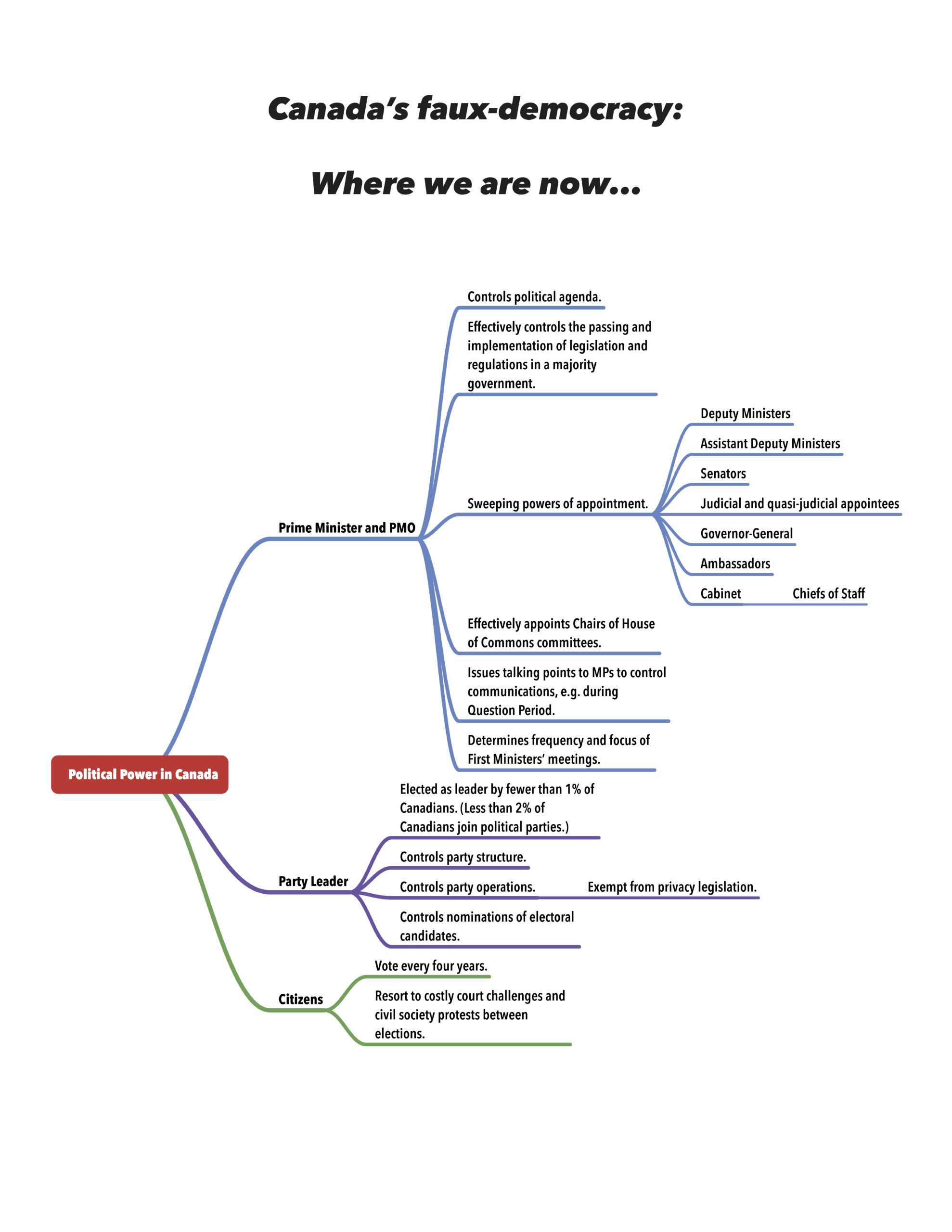
Between elections, the prime minister consolidates his control of parliament through a tentacled PMO and the exercise of his enormous, unaccountable, untransparent discretion. Even serious ethical breaches attract few consequences. The PMO orchestrates the business of legislating and making judicial and administrative appointments with a view to maintaining and enhancing its partisan power, with minimal accountability. The prime minister appoints the chairs of most parliamentary committees and the Chiefs of Staff to cabinet ministers who all report to the PMO, as well as senators, the Governor-General, federal and Supreme Court of Canada justices, heads of Crown Corporations, ambassadors, and more.
With so much power concentrated in the PMO, and no effective checks and balances in parliament, it is not surprising to find that our faux-democratic leaders focus on the short-term and their self-interest in getting re-elected, rather than the long-term interests of the citizens of Canada for whom they hold power in trust. In turn, this alienates citizens who believe they are powerless in a rigged political game.
The visuals below show the distribution of political power in Canada. The first visual sets out the current state of our faux-democracy – with political power highly concentrated at the federal level in the prime minister and PMO.
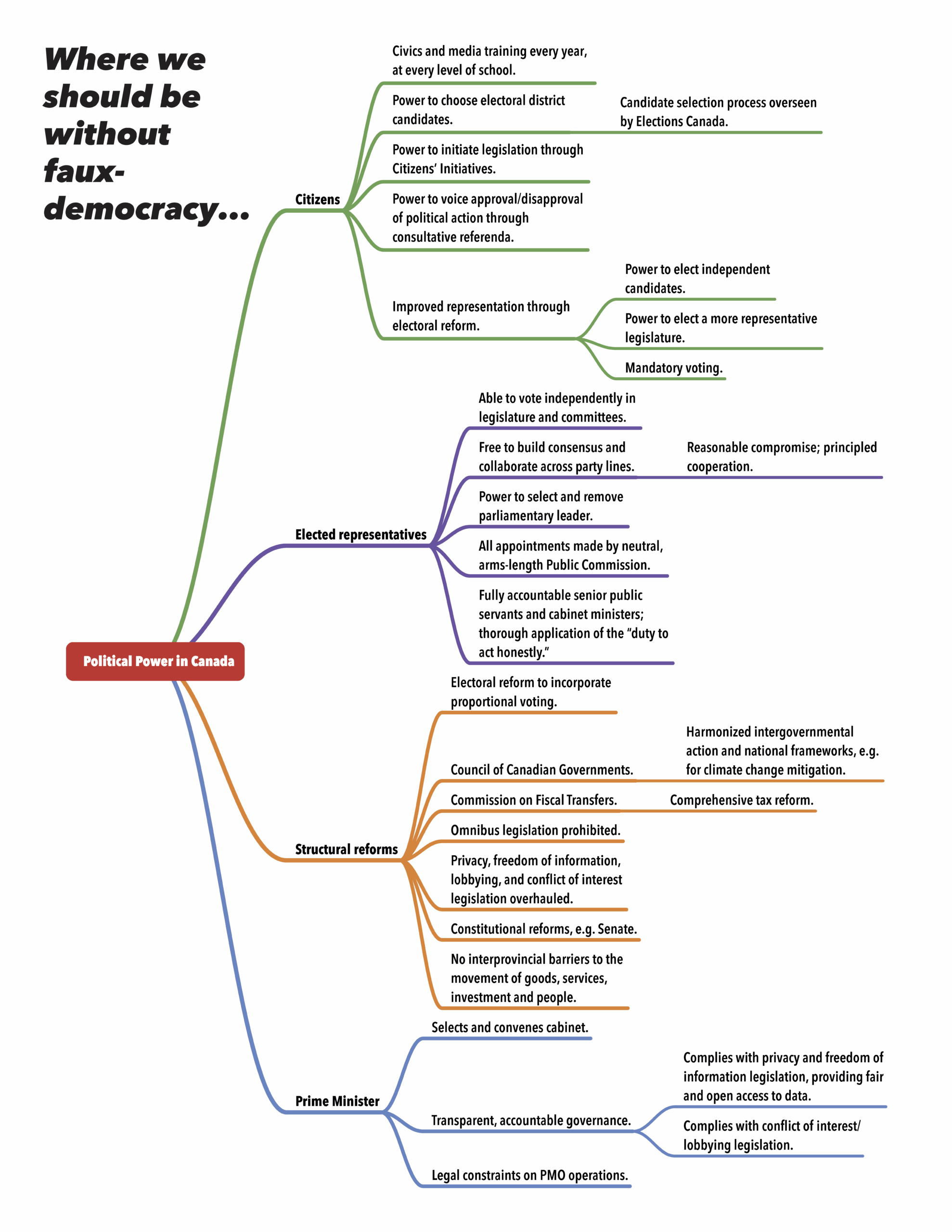
The second visual indicates how, once faux-democracy is ended, citizens would be able to exercise power and ongoing influence in a true Canadian democracy and a stronger, more unified federation.
Let’s start with the faux-democratic governments of Justin Trudeau. Trudeau’s contempt for Canada’s parliament and our democratic foundations became obvious within a year of his 2015 election when he unilaterally cancelled his popular campaign promises to reform the electoral system as well as other structural reforms to ensure greater accountability and transparency in parliament.
Trudeau consistently valued polarization and short-term wedge issues – like carbon pricing and immigration – and micro-managing docile Liberal/NDP MPs out of the PMO, to maintain political power. He accelerated the decay of our democratic institutions and practices; undermined the coherent civic consciousness essential for Canadian unity, and failed to undertake long-term structural changes and policies needed to strengthen our fragmented, dysfunctional federation.
Three consecutive faux-democratic Trudeau Liberal governments left Canada vulnerable to attacks on our economy and security by failing to deal with the following challenges:
- Incoherent foreign, defence, and national security and intelligence policies.
- A balkanized internal Canadian economic market with enormously costly internal barriers to flows of goods, services, investment, and people.
- An incomprehensible, inefficient, and unfair tax system, and costly regulatory and licensing regimes across a jumble of jurisdictions.
- An inequitable post-Covid economic recovery that favours Canadians who already have substantial financial assets, property, and income, while exacerbating inequality and the affordability crisis for the vast majority of ordinary Canadians with precarious incomes.
- Public servants demoralized and sidelined by countless outside consultants hired by political staff, and bogged down by countless bureaucratic processes and procedures preventing effective, efficient service to Canadians.
By the end of 2024, Canadians had thoroughly lost confidence in the federal government’s ability to help improve our standards of living and future prospects. Economic growth, business investment, productivity, and GDP per capita were very weak. Too many Canadians faced long-term stagnation of incomes, with high inflation reducing real incomes further and making basic necessities like food and housing unaffordable.
Enter Donald J. Trump.
Trump is unquestionably unbalanced, amoral, and corrupt, generally governing erratically and unpredictably surrounded by acolytes who feed his narcissism. Unfortunately, Trump is also focused on reinforcing US hegemony in North America and will let whatever is left of NAFTA/CUSMA drift into irrelevance. He will continue to play tariff Whac-A-Mole and other chaotic games with us to destabilize the Canadian economy, and undermine investor confidence. And he intends to extract concessions to ensure that Canada stays firmly within the US orbit, whether as a satellite, or collection of satellites, or “if we want it” as a 51st state.
How did we drift to the point that we were so unprepared for these attacks on our economic and political autonomy, especially after dealing with the first Trump term and the challenging renegotiation of NAFTA?
The answer is NOT Donald Trump 2.0.
It is us.
Our faux-democracy and our dysfunctional federalism have combined to seriously weaken Canada economically and politically, and increase our vulnerability. We are stuck in reactive mode, and not fully able to control the concessions that will now be demanded of us as the inevitable price of our immutable geographic proximity to the US.
Short-sighted, self-absorbed faux-democratic leaders failed to acknowledge and manage Canada’s long-term challenges arising from our dependence on the US for trade and defence. Our leaders should have focused on increasing our economic growth and productivity, expanding opportunities for our growing population, and leveraging our unique geography – a vast territory in North America with valuable critical minerals and resources. Our leaders should have moved firmly to eliminate our federal dysfunction and utter inability to harmonize action across different levels of sub-governments, that now prevents us from presenting a coherent united front as we negotiate new terms of engagement with a US that is an adversary, not a friend.
None of these crucial failures of Canadian leadership were debated in the 2025 election. Canadians’ attention was carefully deflected to fighting Trump, instead of addressing our own underlying failures and weaknesses that made us vulnerable to Trump in the first place.
Policies did not matter in the snap election referred to as “presidentialized.” However imperfectly, Canadians simply decided who was the best fit to manage Trump – Mark Carney or Pierre Poilievre.
The election result was close: the Canadian popular vote was essentially split between the two leaders, confirming that a significant majority of Canadian voters are non-partisan and have no party affiliation. Once again, our antiquated electoral first-past-the-post (FPTP) winner-takes-all electoral system produced an unsatisfactory distribution of MPs across regions – east-central-west, urban-rural – that, at best, does not resonate with us. At worst, the vote exacerbated regional and demographic divides, as too many people voted strategically to avoid a particular result, only to end up with that undesired result anyway.
So, what is next?
The new prime minister, Mark Carney, has plunged ahead with specific initiatives to strengthen our slumping economic productivity and national resilience, and “redefine Canada’s international, commercial, and security relationships.” For the moment, Canadians appear to find the practical action and direction coming from the PMO refreshing.
Among other things, Carney has announced his determination to abolish all trade and labour mobility barriers to ensure a strong internal Canadian economy. This is an important and long overdue project.
But Carney’s Bill C-5 – the One Canadian Economy Act – is only an imperfect first step. The Act will remove barriers to trade and labour mobility in federal jurisdiction only, while the vast majority of barriers are in provincial jurisdiction. And the slowly expanding patchwork of bilateral provincial agreements to reciprocally remove interprovincial barriers to trade and labour mobility, or establish east-west energy corridors, will not boost our internal economy enough to offset the downward pressure from the US.
So, there is much work ahead. Will Carney succeed in implementing meaningful and durable change that strengthens our national economy, national security, and national sovereignty?
There are two serious obstacles.
First, Carney must engage citizens democratically. Instead, he appears to prefer governing faux-democratically out of the PMO without seeking real consensus and compromise in parliament. This failure to engage citizens is not something that can be corrected with more “consultation” on baked-in PMO positions, or more one-way “communications” simply informing Canadians of the details of new policies and projects.
Second, Carney must rebuild a coherent united federation to negotiate more effectively with the US. Instead, he seems content to work within our fundamentally dysfunctional and divided federation, through executive-driven, ad hoc meetings of both the first ministers and the premiers-only Council of the Federation.
Unless Carney can chart a new course to end top-down, short-sighted, faux-democratic governance, encourage compromises that bridge regional and partisan divides, and establish a functional federation that can expeditiously harmonize action across different levels of government and clear out the tangled mess of protectionist provincial/municipal laws and regulations, Canada’s ability to control our future in North America will be compromised. Implementing a so-called “wartime economy” or imposing ineffective counter-tariffs are only band-aid solutions that deflect attention from the internal Canadian crisis eroding the foundations of our democracy and our federation.
This eBook sets out three broad areas of democratic and federalism reforms that are urgently needed to pull Canada back from the edge and ensure our survival as a united independent federation.
The first area of reform is to restore the foundations of constitutional democracy and build a new kind of politics that enables ongoing, meaningful, citizen engagement, and the constructive exercise of citizen power, not just at election time.
The second area of reform is to end faux-democracy: reduce the power of the PMO and encourage genuine collaboration, compromise, and cooperation across regional and partisan divides in parliament. This will greatly enhance the role of MPs (helped by public servants, not high-paid lobbyists and consultants) who bring to the table the views of ordinary Canadians outside the Ottawa bubble.
The third area of reform is to design new federal architecture and rebuild a stronger federation based on transparent, accountable collaboration and harmonization in the national interest across Canadian jurisdictions; something that will then enable the federal government to speak clearly for Canada at home and abroad.
The Canadian federation is fragmented and more uncoordinated than the 27-member European Union. Provincial governments have steadily increased in power since 1867, and understandably prefer to prioritize provincial interests over the national interest. There is no central mechanism within parliament, such as an effective Senate, that could provide a national forum for addressing the concerns of sub-governments through a national lens.
Our future as a sovereign federation now depends crucially on whether we can assert a coherent Canadian presence in both North America and a divided world.
We urgently need a new structure/forum that brings all levels of Canadian governments together to compromise, agree on mutually-satisfactory trade-offs, and establish harmonized Canada-wide national standards to strengthen the Canadian economy, notably in all areas relating to the free flow of goods, services, investment, and people.
Rebuilding a stronger, less fragmented federation that resonates with all Canadians will require us to resolve the renewed threats to national unity surfacing in Alberta and Saskatchewan. These threats, together with the widespread perception that the federal government unfairly accommodates Quebec at the expense of other provinces, especially in western Canada, are gravely weakening Canada.
Most Canadians believe that we cannot continue to accommodate persistent demands from Quebec provincial governments for special deals in the federation. Most Canadians question why we subsidize Bloc Québécois members of parliament who are dedicated to destroying Canadian unity. In building a new intergovernmental forum, the time is overdue to address once and for all Quebec’s status in the federation, and call the question: is Quebec in or out of Canada?
One last point: our federal government must more effectively challenge narrow diasporic political groups in Canada whose leadership, whether inside or outside Canada (see foreign interference in our political party nominations process), too often undermine our ability to build the principled, coherent civic consciousness/identity we need to strengthen our democracy and our federation.
All Canadians want to pull together to build a uniquely compassionate and productive country that is fiercely independent and more than a sum of fragmented parts. We need to end the creeping faux-democracy. We need to rejuvenate our democratic and federal institutions and enable the constructive exercise of citizen power between elections, to support our collective efforts to strengthen national unity, to maintain our sovereignty, and to contribute to global stability.
We must be able to speak with one voice internationally and strengthen Canada’s hand in international negotiations and multilateral forums. Canada must not be drawn more and more into the US orbit with less and less influence, and we must once again play a coherent, constructive role on the world stage to promote peace and security in a rules-based international order.
Click here to download the full eBook
Book Summary [excerpt]
This book stems from an unusual opportunity I had to review my eclectic political activities over the years, and organize almost 40 years of writings and thoughts. My activities were wide-ranging, mainly related to my deep interest in our constitution, our rights and freedoms, the rule of law, our public policies, and international relations. My most constructive political experiences involved popular, citizen mobilization outside of the political establishment, although I also ran for the leadership of the Liberal Party of Canada in 2013 and was a candidate in two federal elections. I remain fascinated by how we can use representative institutions and practices to improve our collective future, and shape a society where preserving the dignity of our fellow citizens preserves the dignity of us all.
In this eBook, I analyze the twin dangers of Canada’s faux-democracy and our dysfunctional federation, the combination of which steadily undermines Canada’s strength and coherence. I set out a roadmap to work around the hollowed-out establishment parties and political machines, and build a true citizen-powered democracy, and a new kind of politics. This means ending government by autocratic, self-absorbed party elites. It means empowering citizens during and between elections through extensive reforms to representative institutions and practices, to support more transparent, responsible, and responsive government. We also need to rebuild our federal architecture to ensure the Canadian federation strengthens, not undermines, national unity and is able to survive the challenges to our sovereignty coming from within and outside Canada.
Either we rise up now and insist on serious reform, or our politics will continue to be dominated by privileged elites who consider it a mere game to be fought and won, and citizens to be manipulated, not served.
Complacency is dangerous. Our future as an independent, united federation is at risk.
The eBook is in three parts:
Part One: Reining in faux-democrats: restoring the foundations of constitutional democracy; strengthening citizen power.
Section 1.1 – The rise of faux-democracy and dysfunctional federalism: Canada on the edge – discusses how the combined rise of Canada’s faux-democracy and dysfunctional federation has alienated citizens and seriously weakened Canada’s sovereignty.
Section 1.2 – Why Meech and Charlottetown matter: lessons in citizen mobilization – discusses in detail the lessons from the historic citizen mobilization that eventually brought down the Meech and Charlottetown constitutional Accords, culminating in the Charlottetown referendum vote in October 1992. Meech and Charlottetown illustrate well the ease with which faux-democratic leaders tried to use the constitution as an instrument to assist in achieving partisan goals.
We need to take steps to ensure our constitution can endure as a vibrant instrument of the people, by the people, for the people, throughout Canada, rather than be weakened by faux-democratic politicians intent on expanding their partisan powers. This is discussed further in sections 1.3 and 1.5.
Section 1.3 – Citizen initiatives and referenda – puts forward proposals for empowering citizens between elections such as through citizen ballot initiatives and consultative referenda.
Section 1.4 – Changing the rules: political engagement and social media today – describes how social media has changed the rules of political engagement and can, with some guidelines, play a positive role in facilitating citizen involvement and holding governments accountable to the people.
Section 1.5 – Constitutional reforms to strengthen our democracy and sovereignty – includes proposals for constitutional reforms to strengthen protections against the arbitrary exercise of power that undermines the rights and freedoms guaranteed equally to all Canadians.
Part Two: Ending faux-democracy: reforms to representative institutions and practices.
Ending faux-democracy requires the methodical implementation of a wide range of reforms to strengthen our representative institutions and practices.
Section 2.1 – Political party reforms: taking back control from political party machines – discusses how insular, unrepresentative, and unaccountable political parties are the major culprits in entrenching faux-democracy, and in turning politics into an elite sport for the select few. This section sets out some political party reforms to eliminate this source of faux-democracy.
Section 2.2 – Election-related reforms: making our vote count – discusses specific overdue election-related reforms. These include an end to our antiquated first-past-the-post (FPTP) electoral system which permits the election of majority governments with less than 40 per cent of the vote, and the election of a parliament that does not reflect the popular vote. More generally, most Canadians feel that their preferred party or candidate does not get elected and that they, therefore, have no real influence in parliament.
During FPTP elections, faux-democrats hone their skills in manipulating the short attention span of the electorate. On election day, they hope we remember only carefully-crafted micro messaging about narrow issues carefully curated by politicians. The focus is on personalities and stunts, vague statements, and word salads, and of course fear. The name of the game is to polarize opinion around wedge issues wherever possible, so that the voter is convinced that one political party or another will do something terrible that must be avoided at all costs. Voters end up voting against something, instead of for something.
This deliberate polarizing of debate around a manufactured fear of the opposition deflects our attention from any substantive policies and proposals to address longer-term economic and social priorities. This means the next government is elected without any clear mandate for which they can be held accountable. And many disadvantaged and alienated citizens in particular then give up on government and are open to listening to, and following, the angry voices of extremist elements whether on the left or right.
In addition to electoral reform, this section also discusses the merits of mandatory voting, and providing much more extensive civics training every year, at every level, in school.
Section 2.3 – Parliamentary reforms: increasing accountability and scrutiny – discusses in detail the many reforms to parliamentary institutions and practices which are essential to holding governments accountable to both parliament and the people and to greater oversight between elections – such as reducing PMO control, eliminating omnibus bills and implementing whistleblower legislation, greater access to information, and stronger privacy oversight, ethics guidelines, and lobbying regulations. Successive governments have failed to implement any restraints to their autocratic powers. The time is overdue for elected representatives to regularly work across party lines and build new governing coalitions outside the parties to stop the democratic decay.
Section 2.4 – Comprehensive tax reform: raising adequate revenues accountably, fairly, and efficiently – addresses the specific subject of raising adequate revenues and undertaking comprehensive tax reform. This topic merits its own section since a fair and efficient tax system is crucial to building a vibrant national economy and encouraging business investment across Canada. It is particularly important now since defending the serious challenges to Canada’s economic and political autonomy requires citizens to be fully confident in the state of our public finances. And without adequate public finance, we cannot deliver effectively on crucial initiatives from defence to housing to addressing the essentials of shared citizenship for all Canadians.
Part Three: Fixing federal dysfunction: new federal architecture, a stronger federation.
Sadly, the inadequate capacity of our federal and provincial governments for long-term public policy planning and constructive collaboration across jurisdictional and other boundaries, has persisted for decades. Interprovincial tensions and resentments continue to undermine national unity and our ability as citizens to pull together to undertake the hard work of building a prosperous Canadian economy and a vibrant true democracy. Meanwhile our federation steadily weakens.
Canada is now on the edge. Action to repair our dysfunctional federal system, and build a stronger united federation, is absolutely crucial as we negotiate new terms of engagement with an adversarial United States determined to destabilize our already fragile economy. If we cannot ensure coherent, effective, and efficient collaboration across all levels of government, Canada will fade into a collection of uncoordinated satellites in the US orbit.
The varied pandemic responses by Canadian governments in 2020-2022 should have been a wake-up call, and is just one of multiple examples of our federal dysfunction that impacts the lives of Canadians every day. Why, for example, were we so slow to change the guidance on masking and travel bans? Why did we so easily forget the lessons of the 2002 to 2004 SARS epidemic and abandon the pandemic early-warning system? Why were we unable to maintain adequate vaccine manufacturing in Canada? Should we now revisit the Emergencies Act and the possibility of a coalition government handling the next emergency more effectively? Is there not a compelling national interest to have common pandemic and emergency rules across the country?
Section 3.1 – Reform of intergovernmental institutions and practices: getting governments to work together, harmonizing fiscal responsibility – discusses how to rebuild our federal architecture, and reform intergovernmental institutions and practices to achieve better intergovernmental coordination. This will strengthen the unity and resilience of our federation to deal with threats to our sovereignty and enable us to assert a coherent Canadian voice in both North America and a divided world.
Intergovernmental dysfunction is a huge factor in so many areas impacting Canadians on a daily basis. Take, for example, our national housing crisis. Crucial action is required across all provinces and municipalities to collectively remove the tangle of costly development charges, zoning regulations, and lengthy approval processes for new construction.
In addition, the multitude of quiet deals concluded between the federal government (read PMO) and separate provinces on various issues, including equalization, are too often regarded as unfair and seed resentment across the federation. More transparency and accountability are required to restore trust and confidence among Canadians and their governments.
One proposal discussed in this section is to establish a Council of Canadian Governments (inspired by an earlier Australian council). The Council would not require constitutional change (as would, for example, reforming and repurposing our current moribund Senate). The Council would promote a tradition of coordination across provincial, municipal, Indigenous and federal governments, and gradually strengthen our coherence as a federation and ability to speak with one voice.
Another proposal is to create an arms-length Commission on Fiscal Transfers to bring transparency, coherence, consistency, fairness, and accountability to the pervasive jumble of federal contributions to the provinces. A simultaneous overhaul of the incomprehensible and divisive equalization program is also necessary.
Section 3.2 – Intergovernmental harmonization of critical policy areas: benefitting all Canadians – discusses five critical policy areas that need serious and sustained intergovernmental harmonization, which would greatly benefit all Canadians and our federal coherence. These are: eliminate barriers to the flows of goods, services, investment, and people across Canada; climate change mitigation; improved income security; coordinated training and support for workers; and improved access to healthcare.
***
Despite the continuous and tiresome refrain that politics is a game and that we cannot expect significant change, I refuse to give up hope for something better. In this eBook, I describe the personal experiences that have informed my political views and some proposals to initiate long overdue change. Even though I have left active politics, I am deeply concerned about the serious democratic decay in our representative institutions and practices, as well as our weakening federation. I trust my observations may contribute to more informed debate about the way forward to end faux-democracy and strengthen Canada.
Canadians must be persuaded that strengthening both our democracy, and our federation, are goals worth fighting for, issue by issue, for as long as it takes. Citizen engagement can play out in many different forums and many different ways, during and between elections. What must unify us is our shared determination to work both inside and outside political parties to build a new kind of politics for all Canadians: a politics which focuses on our serious collective challenges, takes control of the political agenda, and brings about the crucial reforms to our representative institutions, and our federation.
Click here to download the eBook
Canada on the Edge: Canadians must end our faux-democracy now, and urgently rebuild a stronger, united federation is licenced under Creative Commons Attribution Non-Commercial No Derivatives. All material on this website must be attributed to the author(s) or original copyright holder. Website content cannot be used for commercial purposes under any circumstances. Derivative works cannot be created without permission.